The working environment of mining tunnels is harsh, and there are extremely high requirements for the safety, durability, and reliability of accessories. Poor quality accessories may not only cause equipment malfunctions and production delays, but also lead to serious safety accidents. The following is a systematic method for distinguishing the quality of mining tunnel accessories, covering multiple stages from selection to acceptance.
1、 Preparation before purchase: Clarify standards and qualification review
This is a crucial step, to check from the source.
Clarify technical standards and specifications
Benchmarking original factory parameters: Clearly understand all technical parameters such as the specific model, material, size, hardness, torque, pressure rating, etc. of the required accessories.
Follow industry standards: Confirm whether the accessories comply with national mandatory standards (GB), mining industry standards (MT/AQ), or international universal standards (such as ISO, DIN).
Review supplier qualifications
Enterprise qualification: Check the business license and production and operation scope. Prioritize choosing manufacturers or authorized first level agents.
Certification system: It is required to provide quality management system certification (such as ISO9001), environmental management system certification, etc.
Industry access: For safety critical components such as connecting rings, chains, hydraulic support seals, etc., confirm whether they hold the "Mining Product Safety Mark Certificate" (MA mark). This is the mandatory entry threshold for mining safety accessories.
Performance and reputation: Evaluate the supplier's supply history and customer evaluations in similar mining enterprises.
2、 Arrival acceptance: intuitive physical inspection
After the goods arrive at the site, conduct a detailed physical inspection.
Packaging and labeling
Packaging: Formal product packaging is standardized, sturdy, and has clear rust and moisture prevention measures. The information on the packaging box/carton is complete.
Identification: Check the steel seal or label of the accessory itself, which should include: brand, model, material, production batch number/date, execution standard, MA mark (if applicable). Those with vague, missing or incomplete identification should be highly vigilant.
Appearance and craftsmanship
Surface quality:
Cast and forged parts (such as shovel teeth and track shoes): The surface should be flat, without obvious casting defects such as sand holes, pores, cracks, and cold shuts. Polish the rough edges to a smooth finish.
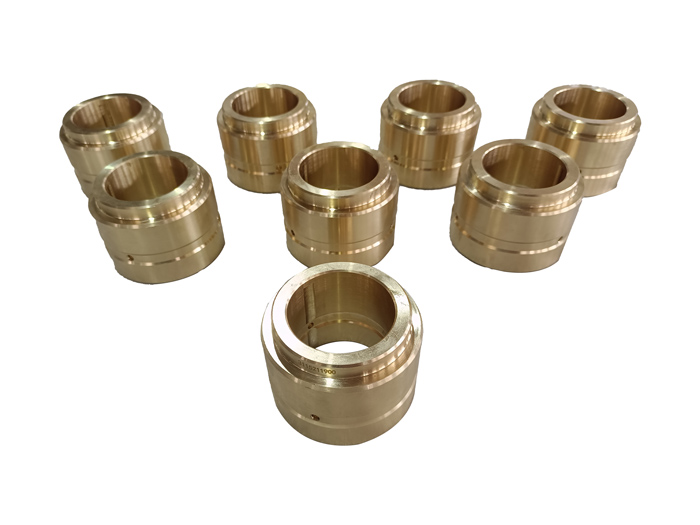
Machining parts (such as bolts, pins, and bushings): The machining pattern is uniform, without burrs, deep knife marks, or bumps. The key mating surface has high smoothness.
Surface treatment: Galvanized and chrome plated parts should have uniform color, no missing plating, peeling, or bubbles. The paint film of the painted parts is uniform and has strong adhesion.
Geometric dimensions and positional tolerances: Use basic measuring tools such as calipers, micrometers, and thread gauges to sample and measure critical dimensions, and check if they are within the tolerance range. Simple assembly test to see if it fits smoothly with adjacent components without any jamming or looseness.
Preliminary assessment of material
Weight comparison: Under the same specifications, accessories made of inferior materials (such as secretly reducing alloy composition or replacing high with low) are often lighter.
Color and luster: Different materials of metals (such as ordinary steel and alloy steel) have differences in color and luster, and experienced individuals can make preliminary judgments.
Hardness testing: Use a portable Leeb hardness tester to perform point testing on claimed high hardness components (such as rock drill bits and cutters) to see if they meet the requirements.
Magnetic testing: can be used to distinguish austenitic stainless steel (usually non-magnetic or weakly magnetic) from ordinary steel.
3、 Performance and Material Verification: In Depth Testing
For important or bulk purchased accessories, laboratory testing should be conducted.
Material composition analysis
Spectral analysis: The use of portable spectrometers can quickly and accurately analyze the chemical composition of metal materials, which is one of the effective means to verify whether the material is "inferior for good".
Mechanical performance testing
Hardness: More accurate Rockwell and Brinell hardness tests.
Strength and toughness: Samples are sent to the laboratory for tensile and impact testing to obtain key data such as tensile strength, yield strength, and impact energy.
Non-destructive testing
Magnetic particle/ultrasonic testing: used to detect defects such as cracks and inclusions inside castings, forgings, and welded parts, which is crucial for structural components such as lifting equipment and connectors.
4、 Example of key distinguishing points for sub item accessories
Fasteners (bolts, nuts):
Check if the level markings (such as 8.8 and 10.9) are clear.
Is the thread complete, smooth, and smoothly engaged.
High strength bolts must be matched with corresponding grade nuts and cannot be mixed.
Hydraulic seals (O-rings, seals):
The material has good elasticity and no long-term deformation, cracking, or burrs.
Oil resistance test (no swelling or deformation after soaking).
The dimensional accuracy is extremely high.
Wear resistant parts (lining plate, bucket tooth tip):
High hardness is the foundation, but at the same time, it requires a certain degree of toughness.
Check the distribution uniformity and bonding strength of the wear-resistant layer (such as tungsten carbide particles).
Electrical components (explosion-proof lamps, sensors):
Whether the explosion-proof structure is complete and whether the explosion-proof surface is smooth and undamaged.
Whether the protection level (IP code) meets the standard.
Relevant explosion-proof certification marks.
5、 Establish a long-term quality control mechanism
Sample sealing: Keep samples of each batch of qualified accessories sealed as a "standard board" for future comparison.
Ledger and traceability: Establish a detailed ledger for the storage, use, and replacement of accessories, recording the brand, batch, and service life of the accessories. Perform root cause analysis on components that were damaged in the early stages of abnormalities.
Supplier performance evaluation: Regularly evaluate suppliers from aspects such as quality, delivery, service, and price, and implement the principle of survival of the fittest.
In summary, distinguishing the quality of mine tunnel fittings is a systematic engineering process that combines "standardization, review, observation, measurement, and management". We must not make hasty decisions based solely on price or appearance. Adhering to the principle of "safety first, quality first", every investment in accessories is laying the foundation for the safe production, efficient operation, and long-term benefits of the mine. For enterprises lacking professional testing capabilities, entrusting third-party authoritative testing institutions to conduct inspections is a wise investment.


